
Key Takeaways
- Polymarket offers Democrats 62% odds of sweeping Congress, whereas Kalshi places the likelihood at 61%.
- The CLARITY Act didn’t advance in September, leaving crypto regulation uncovered to a political shake-up.
- November’s elections might decide whether or not the CLARITY Act will get one other probability in Congress in 2027.
Prediction Markets See a Blue Wave Brewing in Washington
After years of lobbying, hundreds of thousands spent on political campaigns and numerous negotiations over cryptocurrency laws, the business might discover itself again at sq. one. With November’s midterm elections approaching, prediction markets more and more favor Democrats taking management of each chambers of Congress, doubtlessly handing the occasion appreciable affect over the following chapter of federal digital asset regulation.
On Oct. 10, the prediction marketplace Polymarket’s Steadiness of Energy market assigned a 62% likelihood to Democrats capturing each the Home and Senate, with more than $21.2 million in trading volume at press time. A Republican Senate paired with a Democratic Home carried 30% odds, whereas a Republican sweep stood at simply 9%. The reverse association, a Democratic Senate and Republican Home, registered 1%, and different outcomes accounted for lower than 1%.
Kalshi’s competing market paints nearly the identical image. With roughly $35.87 million traded, its contracts give Democrats a 61% chance of sweeping Congress, in contrast with 29% for a Democratic Home and Republican Senate. A Republican sweep instructions 11%, whereas a Republican Home and Democratic Senate stands at simply 0.9%.
The person chamber markets provide one other revealing take a look at the political arithmetic. Polymarket offers Democrats a commanding 91% chance of controlling the Home, with Republicans at 10%, and tasks a 234-201 Democratic majority. Its separate “Blue Wave in 2026” contract carries 87% odds, suggesting merchants anticipate appreciable Democratic features.
The Senate stays a tighter contest. Polymarket offers Democrats 63% odds towards Republicans’ 38%, with roughly $6.23 million traded and a projected 52-48 Democratic majority. Kalshi’s Senate market, which has attracted $57.3 million in quantity, places Democrats at 61% and Republicans at 39%. These figures aren’t ensures, however they reveal the place merchants at the moment consider the political winds are blowing.
Senate Battlegrounds May Determine Crypto’s Regulatory Future
A number of aggressive Senate races assist clarify the Democratic benefit. Polymarket favors James Talarico in Texas at 64%, Troy Jackson in Maine at 59%, Abdul El-Sayed in Michigan at 72%, Mary Peltola in Alaska at 74%, and Sherrod Brown in Ohio at 62%. Republican individuals retain benefits in Kansas, the place Roger Marshall holds 62%, Iowa, the place Ashley Hinson instructions 57%, South Carolina, the place Darline Graham Nordone stands at 85%, and Nebraska, the place Pete Ricketts carries 72%.
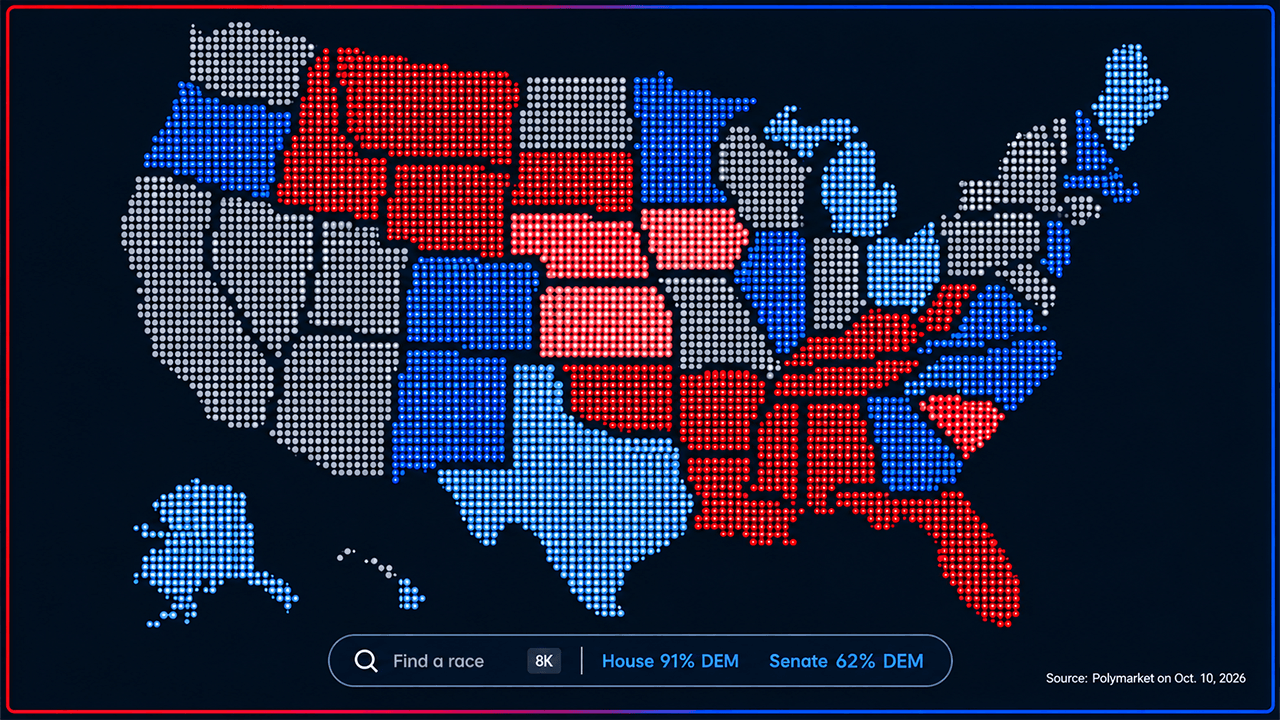
In the meantime, 36 states will elect governors on Nov. 3, with Republicans and Democrats every defending 18 seats. Polymarket favors Xavier Becerra in California at 96%, Greg Abbott in Texas at 77%, Byron Donalds in Florida at 78%, Jocelyn Benson in Michigan at 94%, David Crowley in Wisconsin at 81%, Amy Acton in Ohio at 70% and Aaron Ford in Nevada at 55%. Georgia stays a toss-up, with Rick Jackson at 52% towards Keisha Lance Bottoms at 48%.
Different election-related markets are attracting consideration, too. The state of California‘s proposed billionaire wealth tax carries 25% approval odds, Idaho’s abortion legalization measure stands at 51%, Michigan’s constitutional conference proposal faces an 89% likelihood of rejection, and Colorado’s life-sentence measure for underage intercourse traffickers holds 71% approval odds.
Whereas these gubernatorial and poll contests gained’t decide congressional management, they illustrate the breadth of political wagering forward of November. For cryptocurrency companies, nonetheless, the congressional numbers carry the best penalties.
CLARITY Act Faces an Uphill Battle After September Defeat
The Digital Asset Market Readability Act, generally known as the CLARITY Act, was speculated to settle Washington’s long-running argument over cryptocurrency oversight. Accepted by the Home in July 2025 by means of a bipartisan 294-134 vote, the laws sought to determine clearer duties for the Commodity Futures Buying and selling Fee (CFTC) and Securities and Trade Fee (SEC).
Below the proposal, qualifying digital commodities would fall primarily beneath CFTC supervision, whereas the SEC would retain authority over securities-related actions. Exchanges, brokers and sellers would face registration and disclosure necessities, with sure exemptions out there for mature decentralized networks.
However negotiations finally hit a wall. Regardless of Republicans incorporating 126 substantive modifications requested by Democrats, the Senate rejected a procedural movement Sept. 15, 2026, by a 49-50 vote, falling 11 votes in need of the required 60. Each Democrat current opposed advancing the measure, joined by 4 Republicans.
Disagreements centered on ethics restrictions involving federal officers’ cryptocurrency holdings, illicit-finance safeguards, developer legal responsibility and stablecoin rewards competing with financial institution deposits. President Donald Trump‘s reported cryptocurrency-related revenue exceeding $1.4 billion turned one other sticking level, with Democrats demanding stronger conflict-of-interest protections.
With the present congressional session winding down, the laws’s prospects have successfully collapsed. Any successor would require recent consideration when the one hundred and twentieth Congress convenes in January 2027, doubtlessly beneath Democratic management.
Ten Causes a Democratic Sweep May Put Crypto in a Bind
A Democratic takeover wouldn’t outlaw cryptocurrency or routinely reverse present laws. However, it might make the business’s most popular legislative framework significantly more durable to realize, with ten potential penalties standing out.
First, committee management would change fingers. Democrats would management the congressional panels accountable for monetary companies, banking, and agricultural oversight, giving them authority over hearings, legislative calendars, and negotiations.
Second, the CLARITY Act’s present framework would face a reset. New laws would require reintroduction, and Democratic leaders might demand revisions far past the 126 modifications beforehand negotiated.
Third, ethics restrictions might turn out to be nonnegotiable. Democratic lawmakers have pushed for stronger safeguards governing cryptocurrency earnings involving presidents, senior federal officers, and their households, together with potential divestment and blind-trust necessities.
Fourth, decentralized finance (DeFi) might face harder compliance obligations. Expanded anti-money-laundering provisions involving mixers, noncustodial purposes, and software program builders might enhance authorized publicity and working prices.
Fifth, stablecoin rewards might face tighter restrictions. Banking organizations and a few Democratic lawmakers have raised considerations that yield-bearing stablecoins might divert deposits away from conventional monetary establishments.
Sixth, present company initiatives might encounter resistance. Democratic majorities might problem SEC and CFTC cryptocurrency insurance policies by means of congressional oversight, funding restrictions, and legislative measures, though reversing these guidelines wouldn’t be automated.
Seventh, investigations might intensify. Congressional committees might look at Trump-family cryptocurrency ventures, change custody practices, stablecoin reserves, and political spending throughout the digital asset business.
Eighth, cryptocurrency political spending might lose some affect. Trade-backed organizations similar to Fairshake have dedicated tens of hundreds of thousands to congressional races, together with a reported $30 million effort opposing Ohio Democrat Sherrod Brown.
Ninth, bipartisan negotiations might turn out to be extra difficult. Democrats would possibly prioritize stronger SEC authority, shopper protections, and monetary crime provisions, doubtlessly departing from the business’s most popular CFTC-centered strategy.
Tenth, legislative progress might stretch into 2027 or past. New committee management, competing priorities, and renewed negotiations might delay complete laws, leaving companies depending on present statutes and company interpretations.
Collectively, these prospects counsel a Democratic sweep might considerably change Washington’s strategy to cryptocurrency regulation. Nonetheless, Democrats aren’t uniformly against digital property, and bipartisan help for market-structure laws has existed earlier than. The central dispute considerations what protections and restrictions ought to accompany that laws.
November’s Election May Rewrite Washington’s Crypto Playbook
Even when Democrats seize Congress, Trump would stay president, and laws would nonetheless require his signature or ample help to override a veto. Present regulatory companies would additionally retain their statutory duties, that means congressional management alone wouldn’t immediately dismantle the administration’s cryptocurrency insurance policies.
Prediction markets have one other limitation value remembering. Their chances mirror contract costs, not sure election outcomes, and political developments might change the numbers significantly earlier than Nov. 3. Polymarket and Kalshi additionally use particular settlement guidelines governing chamber management, independents, potential ties and delayed election outcomes.
However, the business’s predicament is turning into troublesome to disregard. Alongside this, even prediction markets themselves could really feel some modifications forward if Democratic leaders take the bulk. After years of negotiations, substantial political spending, and a failed Senate compromise, cryptocurrency firms might enter 2027 going through a completely completely different legislative agenda.
The irony is that the CLARITY Act was supposed to finish Washington’s regulatory guessing sport. As an alternative, with Democrats favored to seize Congress, the cryptocurrency business could quickly uncover that getting laws by means of Washington is one factor, however conserving the political help wanted to complete the job is one other.