
Everybody has heard the Chinese language proverb British misquote: “May you live in interesting times,” and the way it’s presupposed to be a curse. It sounds deep, like a quote for edgelords over 80.
However have you ever ever thought-about the choice? In accordance with the Anglo-Saxon Chronicle, there have been almost two centuries the place nothing a lot occurred. Vivian Mercier famously referred to as Ready for Godot “a play by which nothing occurs, twice.” However nothing taking place 191 instances? I’ll take attention-grabbing instances any day.
And that’s precisely what we have now now. Tether, with their stablecoin USDT, are coming to Lightning. We’ve been speaking quite a bit just lately about how Lightning is the common language of the bitcoin economy and the way bitcoin is a medium of exchange (and it really is; read our report).
These two arguments now appear to be converging. Because of Lightning working as a typical language, it makes bitcoin interoperable with a variety of adjoining applied sciences, like USDT. And USDT goes to turbocharge bitcoin into new use instances, new markets, and new challenges on a scale that the Lightning ecosystem has but to expertise.
Given the selection, I’d quite dive head first into the unknown than spend the afternoon on the sofa. All of the cool stuff is within the unknown. (Picture: pxhere)

Given the selection, I’d quite dive head first into the unknown than spend the afternoon on the sofa. All of the cool stuff is within the unknown. (Picture: pxhere)
USDT on Lightning is terra incognita. Fascinating instances certainly. So let’s take into consideration what it means for USDT to affix Lightning and for Lightning to maneuver USDT — the alternatives, the dangers, and the vast open questions.
Lightning was initially meant to extend the throughput of the bitcoin blockchain, so bitcoin was to be its solely cargo. Taproot Assets is a new protocol that permits fungible belongings (e.g. stablecoins) to be transmitted over Lightning as hashed metadata piggybacking on the identical infrastructure used to course of bitcoin funds.
The way in which it really works is fairly easy for anybody who understands Lightning. The recipient generates an bill that pings edge nodes (i.e. the nodes connecting customers to the broader community) for alternate charges between bitcoin and the asset in query — USDT within the present case. As soon as the consumer accepts an edge node’s alternate charge, they generate an bill for the fee and ship it to the payer. The payer sends the asset to the sting node on their very own aspect, the sting node converts the whole lot right into a normal-looking bitcoin fee, the fee proceeds via routing nodes alongside the community as common, the sting node on the recipient’s finish converts the fee again into the unique asset (USDT) and forwards it to the recipient.
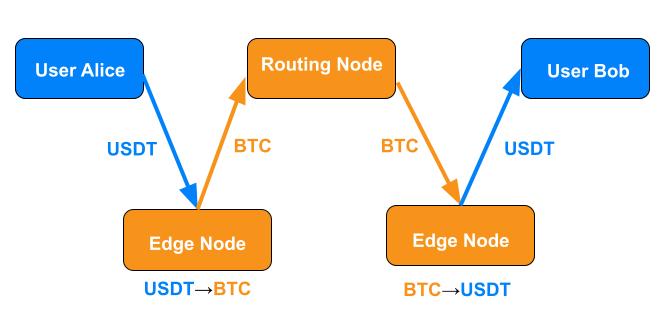
Taproot Belongings leverages the flexibility of Lightning and bitcoin to let customers switch new sorts of belongings over the community, utilizing bitcoin because the common medium of alternate. One corollary of all of the nodes talking Lightning is that any routing nodes between the sting nodes see solely BTC in transit. Lightning tells them the right way to transfer BTC, and that’s all they’re doing so far as they know. Superior.
However there’s extra to it than simply technical specs. USDT is, in any case, a large medium of alternate. Tens of billions of USDT worth change fingers each day unfold throughout hundreds of thousands of funds. Its each day buying and selling volumes are in the identical ballpark because the Brazilian actual and the Indian rupee. It is a huge deal. So what does Lightning imply for USDT, and what does the addition of USDT imply for Lightning?
… for Bitcoin
Thus far, a lot of the technique to bitcoinizing commerce has targeted on orange pilling as many individuals as attainable and rising the circular economy one consumer at a time. This technique has maybe reached the limits of its scale. The circle has grown massively within the final decade and a half, nevertheless it’s nonetheless restricted, and we have to suppose by way of hundreds of thousands at a time.
Now that USDT and BTC are natively interoperable on Lightning, the circle has gained tangents. With USDT on Lightning, every celebration to a fee — the payer and the recipient — can select whether or not to make use of BTC or USDT on their very own finish, and neither depends upon the opposite’s determination. A buyer will pay in BTC, and the service provider can obtain USDT. Or the client will pay in USDT, and the service provider can obtain BTC. Or they’ll each use the identical asset. It doesn’t matter. As soon as each belongings are native to Lightning, they grow to be mechanically, frictionlessly interchangeable. Everyone seems to be free to go for bitcoin’s benefits as a medium of alternate grown from the underside up by the customers or for USDT’s benefits as an asset whose value is as secure as US financial coverage and Tether’s liquid reserves.
Lightning and, by extension, bitcoin stand to realize millions of users and billions of {dollars} price of spending energy. It’s a qualitative extension of bitcoin’s utility. The brand new use instances will do extra good for bitcoin than a boatload of orange tablets. It’s additionally doubtlessly a quantitative explosion for Lightning. Lots of these new customers may not even know that they’re utilizing Lightning because of its efficacy because the common language of the bitcoin economy. However we ol’ faculty Lightning vets know. That is what we’ve been constructing in direction of.

And since we simply talked about how Lightning would make USDT simpler for American customers to entry, USDT can even make it simpler for them to make use of Lightning. American tax regulation treats BTC like an equity, making every fee a doubtlessly advanced concatenation of tax occasions. But when US customers can entry Lightning with an asset that by no means incurs capital positive factors, then they’ll have entry to lots of Lightning’s benefits with out certainly one of its specific regulatory drawbacks.
…for Tether
Tether sometimes points USDT on confirmed blockchains which have achieved vital market traction, and so they have no interest in launching their own. USDT is currently available on Algorand, Celo, Cosmos, Ethereum, EOS, Liquid Community, Solana, Tezos, Ton, and Tron. Observe that these are all proof-of-stake (PoS) blockchains (besides Liquid, which makes use of a federation), in order that they’re essentially extra centralized than bitcoin.
These blockchains additionally face completely different tradeoffs. Ethereum is comparatively decentralized for a PoS blockchain, however its transaction fees are notoriously high. Tron is cheaper. Maybe that’s why, according to one estimate, almost 7x extra month-to-month energetic retail USDT customers go for Tron over Ethereum and ship 8x extra retail quantity over Tron. However Tron is notoriously centralized, making it a choke level for USDT. If Tron have been to fail, Tether would lose one thing like half of its complete capability throughout all blockchains. Ouch. By permitting USDT to be transacted over Lightning, which is inherently decentralized, Tether mitigates their dependency on low cost, centralized blockchains.
Additional, Lightning may make USDT rather more handy to make use of within the US market. US exchanges generally restrict USDT transactions to sure blockchains. For instance, Coinbase says “Coinbase solely helps USDT on the Ethereum blockchain (ERC-20). Don’t ship USDT on some other blockchain to Coinbase.” Lightning provides huge exchanges like Binance, Coinbase, and Kraken (which already help Lightning at this time) a decentralized different for USDT funds to supply their customers.
The brand new American administration has mooted onshoring the whole stablecoin trade and advised that regulating it’s their “first priority.” In different phrases, they’ll be paying very shut consideration to each growth. So long as stablecoins like USDT are pegged to the greenback, those that management the greenback and revenue from it is going to wish to management the stablecoins too.
Regulators suppose they’ll even enhance on freedom by regulating it. They will’t assist it. It’s of their nature. However it follows that, as USDT positive factors utility on Lightning and Lightning positive factors utility as a way to maneuver USDT, we’re all going to be attracting larger scrutiny from regulators. It’s laborious to say how a lot they’ll really have the ability to do or what they’re going to attempt, nevertheless it received’t be any enjoyable. Regulation is at all times friction.
One space that’s more likely to appeal to regulatory scrutiny is the sting nodes. Standard centralized exchanges are typically topic to KYC/AML guidelines in lots of jurisdictions. If the sting nodes shall be mechanically exchanging USDT and BTC and forwarding funds, they may additionally look quite a bit like standard exchanges to regulators, who tend not to like decentralization. 🙄
What’s It Value? What’s It Price?
Whereas Lightning does provide customers and USDT some vital advantages, it’s not clearly the perfect all-around resolution for each fee involving USDT. Lightning customers count on low charges. So do USDT customers who use centralized blockchains and custodial exchanges. However including a second asset to Lightning provides some monetary issues that everybody — routing nodes, customers, and particularly edge nodes — must reckon with.
First, the sting nodes are offering the standard duties of LSPs — maintaining customers linked to the community with sufficient channels and sufficient liquidity to maintain these funds transferring — as well as to changing between belongings. That conversion is a beneficial service that deserves compensation, and it will also be dangerous (see beneath).
Second, USDT is more likely to enhance transaction quantity significantly, which signifies that LSPs and routing nodes must hold extra liquidity on the community to ahead these funds. They don’t take the identical shortcut as custodial exchanges, which simply should replace their inside ledgers. The economics of liquidity allocation nonetheless apply, solely extra so.
Will Lightning have the ability to compete with centralized blockchains like Tron for USDT funds? The reply will most likely resemble the reply to most questions on matching applied sciences with use instances: every know-how may have sure strengths and weaknesses that advocate it for sure use instances and never others. As common, the market will determine it out. Nevertheless, for the reason that know-how wasn’t tailor-made to this specific use case, value discovery shall be a technique of trial and error, which takes time.
Free Name Choices? Uh oh.
Edge nodes face the chance of the “free-call-option problem,” which is attention-grabbing sufficient to benefit its personal dialogue right here. It is a new threat, and it’s inherent to any state of affairs involving two belongings in a single Lightning fee.
Lightning funds should be accomplished inside a sure time to be able to be settled, or the bill cancels mechanically. That point is the “T” in HTLCs — hashed, time-locked contracts.
When the sting nodes bid with their alternate charges for a USDT↔BTC fee, they calculate their bids based mostly on parameters like their present liquidity state of affairs and the spot value. However the customers have a window between accepting the sting node’s bid and the expiration of the HTLC by which to settle the fee. Costs can transfer in that window. If I provoke a USDT fee at one charge, then I can wait till the speed strikes in my favor earlier than I launch the preimage to settle it. If the speed strikes in opposition to me, I merely don’t launch the preimage. In that case, the sting node would possibly provoke a channel closure to redeem their funds, however that’s a gradual (and due to this fact expensive) course of. If it strikes in my favor, the sting node is on the hook for the distinction. Heads, I lose nothing. Tails, I fleece the sting node.
Funds involving any mixture of belongings on Lightning give the consumer a call option. Conventional monetary establishments handle their draw back threat in promoting name choices by including the chance to the worth. These choices can get very costly for unprepared edge nodes. Just ask Kilian and Michael at Boltz, who initially introduced this complete subject to my consideration and had the category to explain it for all of us within the ecosystem. The choice is for the sting nodes to cost the decision possibility into their quotes, similar to conventional monetary establishments. Intertemporal arbitrage is nice work if you may get it.

Customers aren’t the one supply of concern for edge nodes both. If a routing node fails to ahead the preimage — whether or not via intent or malfunction — the sting node may nonetheless be on the hook. Not less than with routing nodes, it could be attainable to implement some type of fame system to assist select the route. Nevertheless, a fame system for finish customers may not be possible as new customers shall be continuously becoming a member of the community.
The free name choices have by no means been an issue for Lightning till now as a result of the community has solely handled a single asset: bitcoin. If the free-option drawback turned severe sufficient, one may think about a number of parallel, single-currency Lightning Networks rising. One for bitcoin. One for USDT. One other for … If bitcoin will get reduce out of the loop, we are going to lose the advantage of bitcoin interoperability. We’d even wind up regretting bringing USDT onto Lightning within the first place.
Bitcoin was at all times meant to be revolutionary. Disrupting damaged fiat is the entire level and at all times has been. We’re in it for the revolution. We all know that change and disruption was by no means going to be a easy course of.
However change is an efficient factor. Progress is only a sort of change that individuals welcome. We welcome USDT on Lightning as a result of we see the chance. It may well signify progress for USDT customers, for Lightning, and for bitcoin.
Like several change, although, it’s going to require cautious thought, preparation, sharp instincts, and fast reactions. You don’t go into uncharted territory with out the best gear and some expertise. Anybody within the Lightning liquidity enterprise goes to face some new challenges, but in addition stands to make some huge positive factors.
Tether stands to realize a cost-effective, decentralized distribution community and higher entry to the important US market. Lightning stands to realize a large infusion of liquidity and customers. Bitcoin shall be natively interoperable with USDT. That’s why there’s a lot pleasure.
However regulators are watching. And edge nodes will solely provide the indispensable conversion providers if doing so is worthwhile, not ruinous. So let’s strategy this modification as we do all new developments in Lightning: by considering laborious, designing rigorously, hardening our code, getting ready the market, and by no means shedding sight of our final objective, which is to understand the common bitcoin economic system.
It is a visitor publish by Roy Sheinfeld. Opinions expressed are solely their very own and don’t essentially mirror these of BTC Inc or Bitcoin Journal.